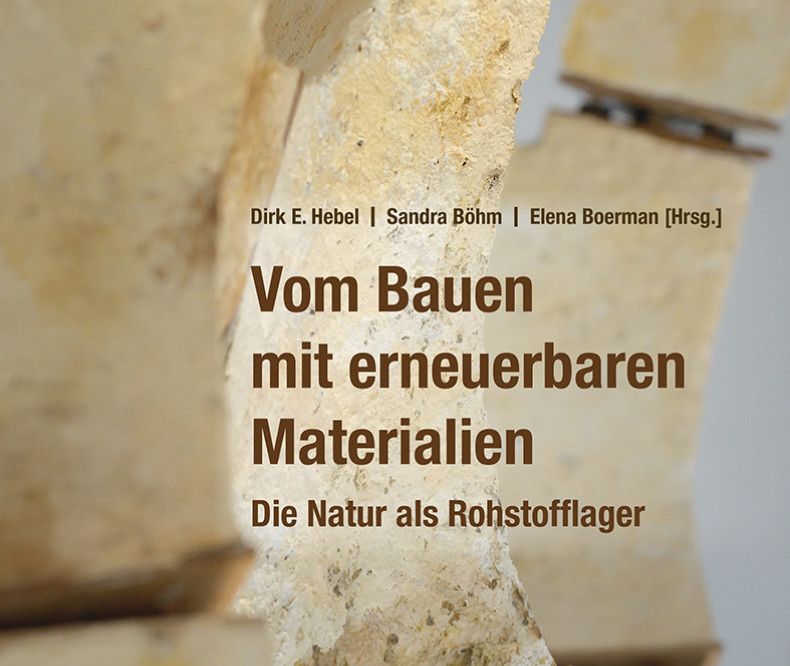
nbau review about “Vom Bauen mit erneuerbaren Materialien”

The editors of the nbau magazine write about the book: “Vom Bauen mit erneuerbaren Materialien is a whirlwind tour through the increasingly important world of the most important biological and geological building materials. Much is already possible today. At the same time, renewable materials seem to hold the promise of a climate-positive future for the construction industry based on a bio-based circular economy. In this sense, the book is both an overview and an appetiser.”
NOV
2024
14

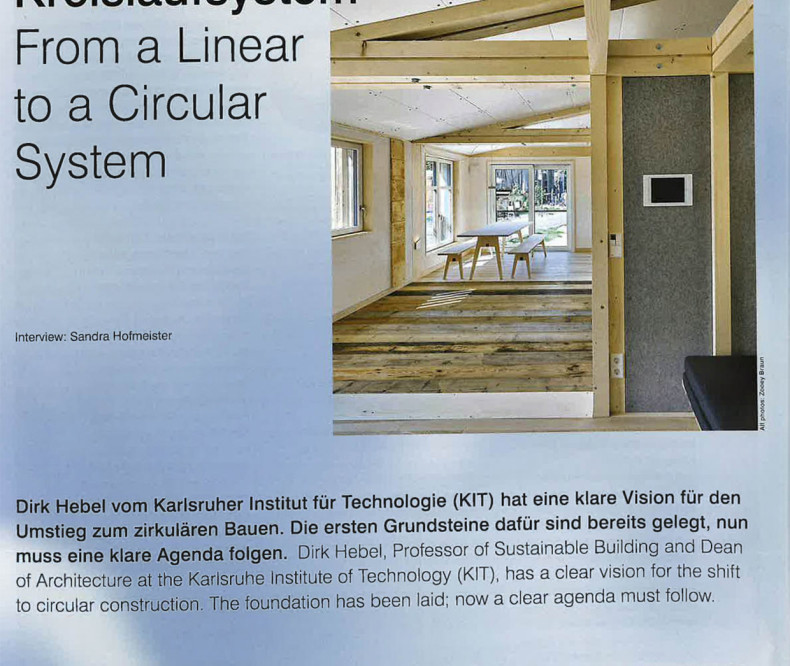
DETAIL-Interview: “From linear to a circular system”

In this interview, Dirk E. Hebel, discusses the urgent need to shift the construction industry from linear to circular processes. Hebel explains how the construction sector can reduce resource waste and CO₂ emissions by adopting a circular economy. He highlights the importance of “design for disassembly,” using pure materials, and reusing entire buildings and components. Through his vision, Hebel introduces an innovative approach to the future of architecture and construction, focusing on sustainability, resource efficiency, and circular value creation.

DEC
2023
18

1,2 or 3 on KiKA: Wonderful world of mushrooms

The children’s quiz “1, 2 or 3” teaches knowledge in an entertaining and playful way. Bright minds and nimble legs are required. The guessing teams give their answers by jumping on one of the answer fields. There are over two million species of mushroom worldwide. And you can not only eat mushrooms, you can even use some of them to build houses. Prof. Dirk Hebel explains how this works. The roots of fungi form a very strong tissue. Reporter Leonore uses this so-called mycelium to produce a kind of leather at the Fraunhofer Institute in Potsdam. She finds out from100

NOV
2023
07

RoofKIT – Interview with Prof. Dirk E. Hebel

“Primary materials are becoming increasingly rare, especially in our resource-poor region of Central Europe. The circular building method can therefore be an answer to the question of how we can still allow future generations to build according to their needs, ideas and values and thus also be able to realize a dignified life.” Prof. Dirk E. Hebel explains the principle of the “anthropocene depot” using the example of the “RoofKIT” in a video interview: the city, the built environment, becomes an urban mine from which raw materials are recovered. The stacking module designed and constructed for the “Solar Decathlon 2022”100

Bending the Curve – Knowing, Acting, Caring for Biodiversity | Trailer

Without biodiversity, human existence on planet Earth would not be possible. However, this biodiversity has been declining for far too long, and at an alarming rate. This realisation unites the curatorial team of the Frankfurter Kunstverein, which has invited the Senckenberg Biodiversity and Climate Research Centre and Frankfurt Zoo to collaborate in the form of an interdisciplinary partnership. The result is the new exhibition titled Bending the Curve – Knowing, Acting, Caring for Biodiversity, which alludes to the concept of ‘Bending the Curve of Biodiversity Loss’. The exhibition explores how the negative trend can be halted – or even reversed.100

OCT
2023
27

SWR Science Talk: How sustainable construction works

Which new materials can be used to construct buildings in an environmentally friendly and natural way? Julia Nestlen gets to the bottom of this question in SWR “Science Talk” with Professor Dirk Hebel. “I am glad that the circular economy is becoming increasingly important alongside the climate issue. It’s necessary that we develop new technologies, that we plan better and smarter for deconstruction (of buildings) and not only for the operation phase.”Prof. Dirk Hebel Giving science a stage: In the SWR series “Science Talk”, experts from various fields give exciting insights into their new research. Every week, a researcher explains100

OCT
2023
06

arte: Twist – Will AI soon be building our homes?

Will AI soon be building our houses? Artificial intelligence is also taking the architecture industry by storm. The internet is full of AI-generated fantasy architecture. Software generates images of houses and interiors from text commands that are real eye-catchers. And they do it in a matter of seconds. So will we soon no longer need architects? Or will AI become a useful tool? Under the editorship of Anette Plomin, Prof. Dirk E. Hebel and other players in the construction industry are confronted with the issues of AI. Prof. Hebel sees the alternative in construction not primarily in AI, but in100

SEP
2023
27

Frankfurter Rundschau: Not enough Sand on the Sea

Due to the worldwide concrete boom, the granular raw material is becoming scarce. In an interview with Clemens Dörrenberg of the Frankfurter Rundschau, Prof. Dirk E. Hebel talks about the overexploitation of an embattled resource and how it could be replaced in construction. The article appeared in the FR7 magazine of the Frankfurter Rundschau on 23/24 September 2023.

DEC
2022
15

WDR planet wissen: The battle for sand

Sand is one of the most sought-after raw materials in the world. The global demand for sand is gigantic and has tripled in the past 20 years. Sand is in the concrete of booming megacities around the world and is important in coastal protection. How do we have to build so that cities can continue to grow in the future? This and many other questions are addressed in the current edition of Planet Wissen, “The battle for sand – new ways of dealing with the coveted raw material. In the second half of the episode, Prof. Dirk E. Hebel from100

DEC
2022
13

Helmholtz: How we build in the future

In the article “How we build in the future”, the Helmholtz Association presents sustainable, climate-friendly solutions from architecture and construction research. In this context, Prof. Dirk E. Hebel presents the RoofKIT project of the KIT Faculty of Architecture as an innovative lighthouse project for circular justice, purity of types, recycling and reuse, and the resource-friendly handling of materials. Concrete as a building material is then critically examined. Prof. Frank Dehn, Institute Director at the KIT Civil Engineering Faculty, is researching climate-friendly alternatives and the use of old concrete. In addition, other forward-looking topics such as the “sponge city” and the100

NOV
2022
29

Gernot Minke: Building with Bamboo

The new book by Gernot Minke entitled “Building with Bamboo – Design and Technology of a Sustainable Architecture” was recently published by Birkhäuser Verlag. In addition to material information and properties, it also contains application examples from research and practice. In the chapter “Reinforcing with Bamboo”, among other things, research projects of the Sustainable Construction Professorship at the Karlsruhe Institute of Technology are presented.

OCT
2022
14

RoofKIT in Re: on arte – How mycelium researchers are working on the future

In this report, arte investigates the power of mushrooms and visits various actors. A Swiss mushroom expert, for example, wants to restore polluted soils. Researchers are also working together with students on a biological packaging material made from mushrooms. Mushroom leather or stable insulation and building materials are also examined in this episode of Re:. The reporters also visit the Solar Decathlon in Wuppertal. Prof. Dirk E. Hebel explains why the mushroom, as a biologically renewable raw material, could become an important component of the future sustainable construction industry within planetary boundaries and in line with the European Green Deal.

JUN
2022
11

RoofKIT opened for public at SDE Europe 21/22 in Wuppertal

The Karlsruhe Institute of Technology is participating in the 2021/22 Solar Decathlon Competition in Wuppertal, Germany with its project RoofKIT. Designed as a top-up to an existing structure of the 19th century in the old city fabric, it demonstrates a vision for the building industry: social adequate, energy positive and circular sustainable. It is the unique character of the Solar Decathlon competition, that next to an overall design approach of a larger project, a characteristic element is constructed as a full scale demonstrator. Since 2020, more than 100 students from KIT within different faculties and under the leadership of the100

DEC
2021
09

Solar Decathlon in Wuppertal: RoofKITs vision for Café ADA

The magazine Haus und Grund Wuppertal published an article in its 10/2021 issue about two projects in the SolarDecathlon 2021, which will take place from 10 to 26 June 2022 on the Nordbahntrasse opposite Mirker Bahnhof. DETAIl also reports on the project of the Karlsruhe team RoofKIT in an online series entitled “A Future for Existing Buildings”. The Solar Decathlon is probably the best-known international student competition on the topic of sustainable building and living. Among the projects published in this issue is Team RoofKIT’s vision for Café ADA in Wuppertal. RoofKIT is an interdisciplinary team of students from the100

NOV
2021
08

“Sustainable Architecture” – Scientists for Future Podcast

The Scientists for Future podcast features monthly conversations with scientists about climate change, sustainability and a livable future. The building sector is responsible for around 40% of CO2 and greenhouse gases in Europe. The Scientists for Future took this initial situation as an opportunity to join forces with the Architects for Future and dedicate an episode of their podcast to the topic of architecture. To do so, they invited Prof. Dirk Hebel from Professorship of Sustainable Construction at the Karlsruhe Institute of Technology. “We have to understand our buildings as material stores,” he describes. In addition to the question of100

NOV
2021
04

The Professorship of Sustainable Construction represented in the lookKIT magazine “BAUEN”

In this year’s third edition “BAUEN” of the KIT magazine for research, teaching and innovation “lookKIT”, three different articles report on research and other topics taking place at the Professorship of Sustainable Construction at the Karlsruhe Institute of Technology. Under the title “Realizing recycling-oriented Construction”, Dr. Stefan Fuchs conducted an interview with Prof. Dirk E. Hebel, Sandra Böhm and Daniela Schneider from the Professorship of Sustainable Construction. The topics of the conversation range from the protection of resources to the problem of land consumption and the need for new forms of living. According to the researchers, in order to anchor100

NOV
2021
02

“A home for the future – climate-friendly building and living” – WELTWUNDERKUGEL podcast by SWR

The climate podcast WELTWUNDERKUGEL from SWR deals with topics related to the function of our planet. The makers are interested in understanding what defines our earth and the climate and how we can hand over a healthy earth to future generations. The current episode “A home for the future – climate-friendly building and living” is about sponge cities, high-rise forests, eco-villages and biological building materials. In the search for the “Home of the future”, voices from science and society are heard and various projects on the topic are presented by the SWR1 editor Christiane von Wolff. In this context, Dirk100

MAY
2021
18

Urban Mining – New episode of the RoofKIT podcast “Fighting 40%”

The podcast “Fighting 40%” was created as a part of the international competition Solar Decathlon Europe 21. The RoofKIT podcast team presents topics relating architecture and urban design, but above all sustainability and future-oriented thinking. In the current second episode released on 10 Mai 2021, two podcast team members discuss about “Urban Mining” with Prof. Dirk E. Hebel, the Faculty Advisor of team RoofKIT. Since the post-war period, we have been surrounded by an anthropogenic warehouse of over 50 billion tons of material. This warehouse grows every year by another 10 tons per inhabitant. Much of it is located in100

APR
2021
27

“The construction industry needs a radical turnaround”

The two architecture master’s students Alisa Schneider and Elena Boerman report in the KIT student magazine clicKIT about their activities in the local group of the nationwide association Architects for Future in Karlsruhe. In their work, the two are committed to ensuring that the building industry experiences a sustainable and future-oriented turnaround. Among their demands as Architects for Future are the critical questioning of building demolitions, the increasing use of healthy, regional and climate-positive materials instead of cheap and foreign materials, circular construction and the perception of the urban mine as a storehouse of materials, as well as the preservation100

APR
2021
06

Urban Mining & Recycling (UMAR) on Instagram @neweuropeanbauhaus

The Urban Mining and Recycling unit (UMAR) in NEST was listed as a showcase project of circular construction by the New European Bauhaus on 6th April 2021. The project shows how a responsible approach to dealing with our natural resources can also go hand in hand with an appealing architectural form. Life-cycle thinking has led the design process: all the resources required to construct the unit are fully reusable, recyclable, or compostable. The Urban Mining and Recycling housing and research unit in NEST, the modular Research and Innovation Building of Empa in Dübendorf (Switzerland), is demonstrating what a paradigm shift100

MAR
2021
30

planet e. by ZDF: The trick with the rubble

The current episode of planet e., a documentation series by ZDF, examines the state of sustainability in the German construction industry and shows perspectives for building with recycled concrete and products out of construction waste. This is because the construction industry in Germany is responsible for more than half of the waste generated, accessible raw materials are becoming increasingly scarce, and the production of building materials such as cement causes greenhouse gases that contribute significantly to the warming of the atmosphere. Nevertheless, construction waste in Germany still ends up in landfills to a large extent. Only a few companies in100

MAR
2021
10

Xenius by arte: Future building materials

In a new episode of Xenius by arte, the hosts Dörthe Eickelberg and Pierre Girard set out in search of alternative building materials. Up to now, the building industry has mainly used concrete and steel. In order to be able to build more ecologically and sustainably in the future, scientists are looking for alternative building materials. And there are some innovative ideas. Mycelium, paperboard or popcorn – nothing is impossible! The hosts also interview Prof. Dirk E Hebel about his research with mycelium as an alternative, cultivated biological building material. The mycelium is simply fed with biological waste and can100

UMAR and Mycelium Research in “Die Sendung mit der Maus”

In the current 50th anniversary episode of “Die Sendung mit der Maus”, Armin Maiwald, one of the hosts, is looking for how people will live in the future. Therefore he visits the Urban Mining and Recycling Unit (UMAR) created by Werner Sobek with Dirk E. Hebel and Felix Heisel. The building design demonstrates how a responsible approach to dealing with our natural resources can go hand in hand with appealing architectural form. The project is underpinned by the proposition that all the resources required to construct a building must be fully reusable, recyclable or compostable. This places life-cycle thinking at100

Sorge um den Bestand. Ten strategies for architecture

The KIT professorship of Sustainable Construction at the Faculty of Architecture is part of an exhibition and publication by the Association of German Architects BDA. In ten strategies, architects and urbanists present their concern for the existing building: taking care of the building stock, for growing social structures and for the continued existence of the earth. They invite you to read the permanence of what has been built and what has grown and plead for further thinking and careful repair of living spaces and living cultures. They show how new perspectives arise in the urban and regional context through networked100

Design through and with material knowledge

An interview with the Dean of the KIT Faculty of Architecture Dirk E. Hebel and seminar leader Sandra Böhm of the Professorship of Sustainable Construction about their design strategies and the compatibility with materials science in architectural education. The KIT Faculty of Architecture has a long tradition in understanding architectural design in close interaction with and in dependency on structural design, building construction, building physics, social studies and material science. The students deal critically and actively with the pressing questions of our times and are looking for ways to align their own actions with these findings. [slideshow_deploy id=’7608′] The focus100

Highrises of the future will be build with mycelium, hemp and bamboo

An article at Spiegel-Online describing future scenarios of the building industry with Prof. Dirk E. Hebel. By Ulrike Knöfel. more information here

The power of mushrooms

Mushrooms are given little attention – but are they the secret rulers of the world? “PUR +” presenter Eric Mayer discovers new possibilities and also visits the KIT-MycoLab of Prof. Dirk E. Hebel and his research team around Dr. Nazanin Saeidi and Dr. Alireza Javadian to understand how a new class of building materials could be cultivated.

OCT
2020
28

Zukunft Bauen – Hat die Kreislaufwirtschaft auf dem Bau eine Chance?

Prof. Dirk E. Hebel in discussion about a rising circular building economy. A talk in “Zukunft Bauen” with Prof. Dirk E. Hebel (Sustainable Construction, Faculty of Architecture, KIT Karlsruhe) and Dr. Lamia Messari-Becker (Building Technology and Building Physics, Institute of Architecture, University of Siegen) about rethinking the construction industry and its bound building materials as a raw materials warehouse in order to preserve the earth’s resources and about the paradigm change in future architectural planning and construction.

ZDF films at KIT MycoLab

The public German TV station ZDF films at the KIT MycoLab for their format PUR+. PUR + is the discovery magazine in the children’s and youth program ZDFtivi. Each episode deals with one topic. Reports, explanations, and experiments shed light on the topic from different angles. The program focuses on the experiences and assessments of children. At KIT, Eric, the protganist of the format, explores together with the team of Prof. Dirk E. Hebel and Nazanin Saeidi the idea of using mycelium as an innovative building material of the future.

Tremendous possibilities – the city as a raw materials warehouse

KIT professor Dirk E. Hebel writes about Germany as a country with an incredibly large anthropogenic material store but with a lack of ideas how to use it. Our cities have the potential to be transformed into urban mines, to consumers and suppliers of resources. The challenge of an infinite cycle of resources lies in new construction methods and technologies to reach a new generation of building materials and methods that are qualitatively sustainable, ecologically harmless, technically pure, economically attractive and endlessly recyclable. The Mehr.WERT.Pavillon serves as a clear example for this. All materials used in the project have already100

Tremendous possibilities

Hebel, Dirk E. (2020). Ungeheure Möglichkeiten, in: der architekt. material der stadt. 4/2020 (Bund Deutscher Architekten BDA), Berlin, Germany

Radio interview: Architecture of mushroom and bamboo – Dirk E. Hebel talks about constructing sustainability

Marie-Dominique Wetzel, cultural correspondent from SWR2, talks with KIT professor Dirk E. Hebel about his vision of sustainable architecture as a part of the movement against climate change and the destruction of the environment. He emphasizes the importance of research on new building technologies in consideration of the fact that the earth’s resources are more and more declining. Therefore a change in awareness to the cycle-oriented and gradual use of building materials is inevitable for present and future architects. Video on: https://www.swr.de/swr2

KIT Faculty of Architecture students win Urban Mining Student Award

The winners of the third Urban Mining Student Award have been announced: From the total of 20 submitted design proposals, the jury awarded two first prizes and five recognitions. One of the two first prizes went to Jan Matthies & Andrea Santos Rodríguez from the KIT Faculty of Architecture. Hannah Hopp, Viola Winterstein, Laura Ganz and Pia Thisssen were delighted to receive recognitions. The design of Jan Matthies and Andrea Santos Rodríguez convinced the jury mostly by their consequent use of existing building elements coming from the urban mine and their ability to create unique and high quality spatial arrangements100

Sandra Böhm with her furniture series “Prei” at SWR

The furniture series Prei is made up of used paper and includes a variety of stools, a bench, trash bins and a shelf. The project was already born several years ago out of the wish to create hand-crafted products from recyclable materials. Used paper is a ressource that constantly surrounds us. The addition of natural additives creates a stable material. Vegetable dies give the objects their final charakter and offer a color variety. Video on: www.ardmediathek.de More information on: www.sandraboehm.de

MAR
2020
24

We’re running out of sand!

The quantities are gigantic: mankind currently consumes 40 to 50 billion tons of sand per year. This is the result of a study carried out by the UN Environmental Programme UNEP in 2019, making sand one of the most important trading raw materials of all and the second largest traded and mined resource of our time after water. Prof. Dirk E. Hebel in: Sakowitz, Sven (2020). Uns geht der Sand aus, HÖRZU Wissen.

Dr. Nazanin Saeidi MIT Technology Review’s emerging innovator

Dr Nazanin Saedi, as of April 2020 part of the KIT research team at the Professorship of Sustainable Construction, was named one of the 20 emerging innovators in Asia Pacific by MIT Technology Review for her work on sustainable construction materials. Dr Nazanin Saeidi is among MIT Technology Review’s ‘20 Innovators Under 35’ for the Asia Pacific region. In association with EmTech Asia 2020, the list celebrates 20 researchers, inventors, and entrepreneurs who are changing the world. As postdoctoral researcher in the Alternative Construction Materials project headed by Prof. Dirk E. Hebel at the Future Cities Laboratory in Singapore, Dr100

FEB
2020
25

Diskrepanz zwischen Anspruch und Realität ist groß & Die Stadt wird zum riesigen Rohstofflager

Ulrich Coenen, BNN: Interview with Prof. Dirk E. Hebel (2020) The two-part-interview is about Sustainable Thinking, Acting and Building, technical and biological circulations, unmixed and pure construction methods and the application and practice of urban mining. Furthermore they discuss practices of energetic redevelopment of existing buildings and the establishment of new building materials and future energy efficient technologies. in: Badische Neueste Nachrichten, 11th & 18th February 2020: no. 34 & 40

JAN
2020
22

Urban Mining and Recycling (UMAR) and Research Seminar ‘Bau auf!’

Urban Mining and Recycling (UMAR) The Urban Mining and Recycling (UMAR) housing and research unit in NEST, the modular Research and Innovation Building of Empa and Eawag in Dübendorf (Switzerland), is demonstrating what a paradigm shift in the construction industry reacting to the limitation of the world’s natural resources might look like. Turning away from linear material-consumption and towards an economy of material recycling, multiple use, alternative construction methods and the use of entirely separable materials – UMAR works as a material laboratory but also as a material depot. It is a proof that the responsible use of natural resources,100

Michael Hosch receives honorable award in the University Competition for Modern Expansion and Lightweight Construction 2018/19

Michael Hosch received this honorable mention award with his semester project “MICMAC – MICRO UNITS – MACRO BENEFITS”, conceived in the 5th semester of bachelor studies at KIT under the guidance of the Professorships Sustainable Construction (Hebel, Lenz, Rausch), Building Physics (A. Wagner) , Structural Design (M. Pfeifer) and Building Economy (K. Fischer). The university initiative “Modern Expansion and Lightweight Construction” has set itself the task of working together with universities to advance teaching in this field by organizing – among other activities – this university competition. Image © copyright by Thomas Müller

Lukas Gerling wins KIT-Sparkassen Environmental Award 2019

Lukas Gerling wins with his Master-Thesis “Future Fessenheim” developed under the guidance of the Professorships of Sustainable Construction Dirk E. Hebel and Landscape Design Prof. Henri Bava the KIT-Sparkassen Environmental Award 2019. His work on the future of the nuclear power plant in Fessenheim was seen by the jury as an highly impotant and socially relevant theme within the international border area of France and Germany. With extraordinary precision derived from his critical-theoretical approach, he developed a design that combines different interpretations, states of memory and fear, architectural elements from present and past, international actors and new local actions. The100